Academic project — Java Backend
Construction Site Management System
Supply and inventory management app for construction sites, deployed as .jar files.
01
The starting point
Bring inventory, orders and planning into a desktop application with a history of material movements.
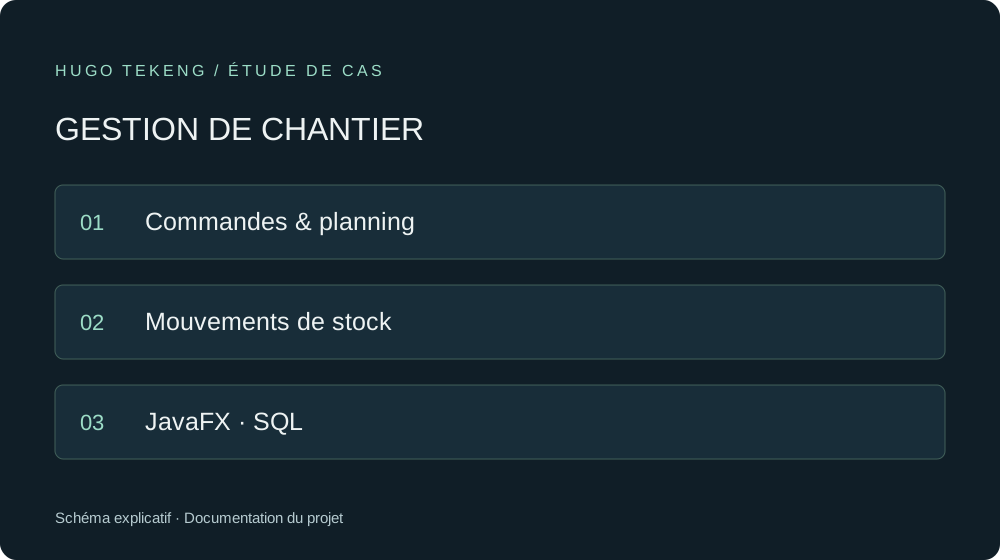
Development of a desktop application for managing supplies and inventory on a construction site, with order tracking, planning, and full traceability. Deployed as .jar files on Windows.
02
How it works
- 1JavaFX interface
- 2Orders & planning
- 3Inventory movements
- 4SQL persistence
Architecture & implementation
- Functional analysis of construction site needs.
- Backend development and Java UI with JavaFX.
- Order management, inbound/outbound stock, planning, and traceability.
- Object-oriented design, testing, and debugging.
- PostgreSQL database for data persistence.
- Application deployed as .jar files on Windows.
Technical decisions
- JavaFX for a native, rich GUI without web dependencies.
- PostgreSQL for relational robustness and complex query management.
- .jar deployment for simple Windows installation without a server.
Lessons learned
- Upfront functional analysis avoids surprises during development.
- JavaFX offers good graphical richness for business desktop apps.
- .jar deployment simplifies distribution without server infrastructure.
Possible next steps
- Add automatic low-stock alerts.
- Generate PDF supply reports.
- Migrate to a web app for multi-user access.
03
Results & practical value
- Delivery of a Java application as a Windows JAR and implementation of inventory inflow/outflow tracking.
Delivered so far
- Functional desktop application deployed as .jar on Windows.
- Inventory, order, and planning modules operational.
- Full stock movement traceability.
- Testing and debugging completed.
04
Scope & limitations
- Functions are documented; material and time savings have not been measured.
Source: portfolio documentation. Functional diagram, without construction-site operating metrics.